Smart Workload Management: How to Allocate Tasks Fairly and Sustain Team Performance
Fair task allocation does not mean giving every employee the same number of tasks.
One complex, time-sensitive assignment may require more time and effort than several short tasks. Employees also differ in their skills, existing commitments, working schedules, and actual availability.
Smart workload management therefore starts with a more useful question:
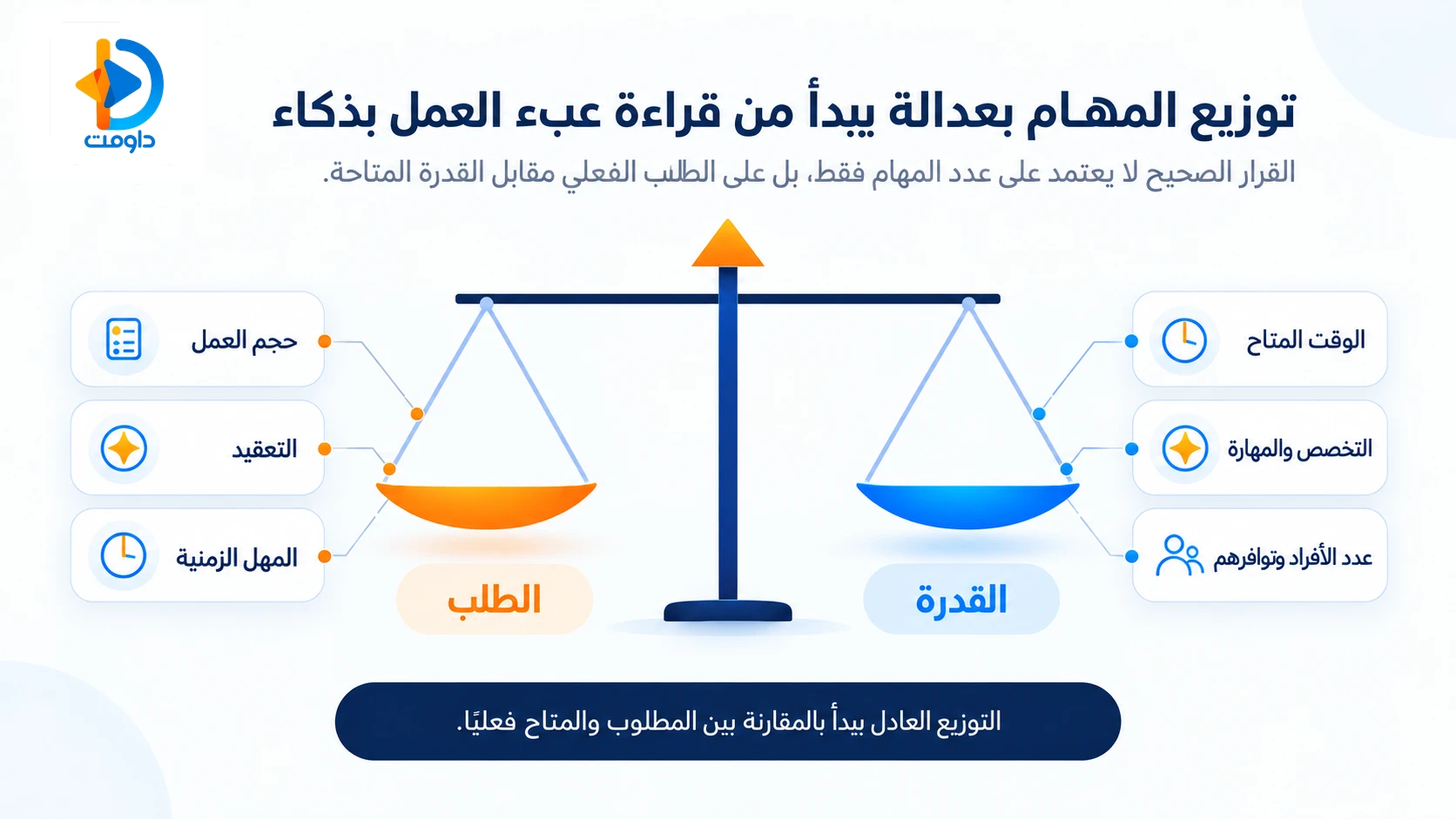
What work needs to be completed, and what capacity is actually available to deliver it?
Once this picture is clear, managers can distribute work more realistically, identify bottlenecks earlier, and rebalance tasks before workload imbalance develops into recurring delays or sustained pressure.
Workload management is the process of comparing work demands with the time, skills, and resources available to deliver them, then allocating and reviewing tasks according to priorities and actual operational capacity.
In practice, organizations should consider two sides of the equation.
Work Demand
This may include:
• The volume of active projects and tasks.
• Task complexity.
• Deadlines.
• Operational priorities.
• Coordination required with other teams or stakeholders.
Available Capacity
This may include:
• Actual working time available.
• Staffing availability.
• Relevant skills and expertise.
• Existing projects and assignments.
• Leave, shifts, meetings, and other operational commitments.
This is why task count alone is not a reliable measure of workload.
An employee may have only three tasks that consume most of the working week, while another may be able to complete a larger number of shorter or less complex tasks.
The World Health Organization identifies excessive workloads or work pace, understaffing, long or inflexible working hours, and limited control over workload among psychosocial risks in the workplace.
The UK Health and Safety Executive's Management Standards also emphasize that job demands should be adequate and achievable within agreed working hours and that people's skills and abilities should be matched to job demands.
There is no universal numeric threshold that automatically determines when an individual employee is “overloaded.”
A more useful approach is to review several operational signals within the context of the team and the work being performed.
From a working-time perspective, the International Labour Organization reports that more than one-third of workers globally regularly work more than 48 hours per week.
This statistic illustrates the prevalence of long working hours worldwide, but it should not be interpreted as a universal definition of excessive workload for every organization or role.
No single indicator is sufficient. Repeated operational patterns are more useful.
If the same employees consistently work additional hours while capacity may exist elsewhere, task allocation, skill coverage, or dependencies should be reviewed.
Recurring delays do not automatically indicate poor individual performance.
The original effort estimate may have been unrealistic, competing priorities may exist, or workload may not have been allocated according to actual availability.
If several tasks are all treated as the highest priority, prioritization itself becomes part of the workload problem.
Employees cannot execute multiple first priorities simultaneously.
If essential work can only be completed by one employee, that person can become a bottleneck even when total task volume appears manageable.
The solution may require knowledge sharing, backup capability, or skill development, not simply moving tasks.
The issue may sometimes be resource allocation rather than a total shortage of resources.
Repeated changes may indicate that planning does not accurately reflect actual demand or staff availability.
Before allocating new work, consider four dimensions.
Work Volume
Complexity
How much expertise, concentration, review, or coordination does the work require?
Two tasks may be equal in number but completely different in effort.
Time and Priority
When must the task be completed?
Where does it sit compared with other priorities?
Available Capacity

Contracted working hours should not automatically be treated as fully available capacity. Employees may already have meetings, leave, shifts, recurring operational duties, or other active projects.
Does Fair Task Allocation Mean Equal Task Counts?
No.
Operational fairness does not mean giving every employee five tasks.
Work should instead be considered in relation to:
• Expected effort.
• Complexity.
• Priority.
• Skill and experience.
• Actual time availability.
• Existing commitments.
The objective is not to distribute task counts equally. It is to distribute work and responsibility in a way that can realistically be delivered.
Practical Steps for Smarter Workload Allocation
1. Build a clear view of current work
Start with active projects and tasks, their owners, deadlines, and priorities.
It is difficult to allocate new work objectively if existing work is not visible.
2. Prioritize before allocating more work
Separate work into:
• Urgent and important.
• Important but schedulable.
• Work that can be delayed.
• Work that may no longer be necessary.
Delaying or stopping low-priority work can sometimes be more effective than adding resources.
3. Review each employee's actual capacity
Consider:
• Available working time.
• Leave.
• Shifts.
• Meetings.
• Existing projects.
• Required expertise.
4. Assign based on skills and availability
The most experienced employee is not always the best choice if that person's schedule is already fully committed.
Another employee with the required skills and greater availability may be better positioned to complete the task on time.
5. Avoid excessive simultaneous work
Too many open tasks can create competing priorities and repeated context switching.
Keeping active work visible and reviewable helps teams make clearer decisions about what should be worked on now and what should wait.
6. Review workload regularly with the team
HSE guidance includes practical management approaches such as clear work plans, regular team discussions about anticipated workload, and individual discussions about expected challenges.
The objective is not to monitor employees excessively, but to identify workload issues before they become recurring delays.
7. Rebalance when circumstances change
Work plans are not static.
Unexpected leave, a new project, supplier delays, changed deadlines, or revised priorities are all valid reasons to reconsider task allocation.
8. Measure the effect of rebalancing
After changes are made, review:
• Has overtime become less concentrated?
• Have overdue tasks decreased?
• Are fewer tasks being reassigned?
• Are priorities more stable?
• Do important bottlenecks still depend on one person?
Imagine a team of four employees.
Employee A has only three tasks, but they are complex and close to deadline.
Employee B has seven tasks, but they are short and repetitive.
Employee C has available time but does not have the required expertise for some of Employee A's work.
Employee D has the required expertise but will be partially unavailable during the week because of leave.
Giving everyone the same number of tasks might look fair on paper, but it would not create an effective workload distribution.
A better approach considers expected effort, skills, available time, project priority, and deadlines, then reallocates only the work that can be moved without creating another operational problem.
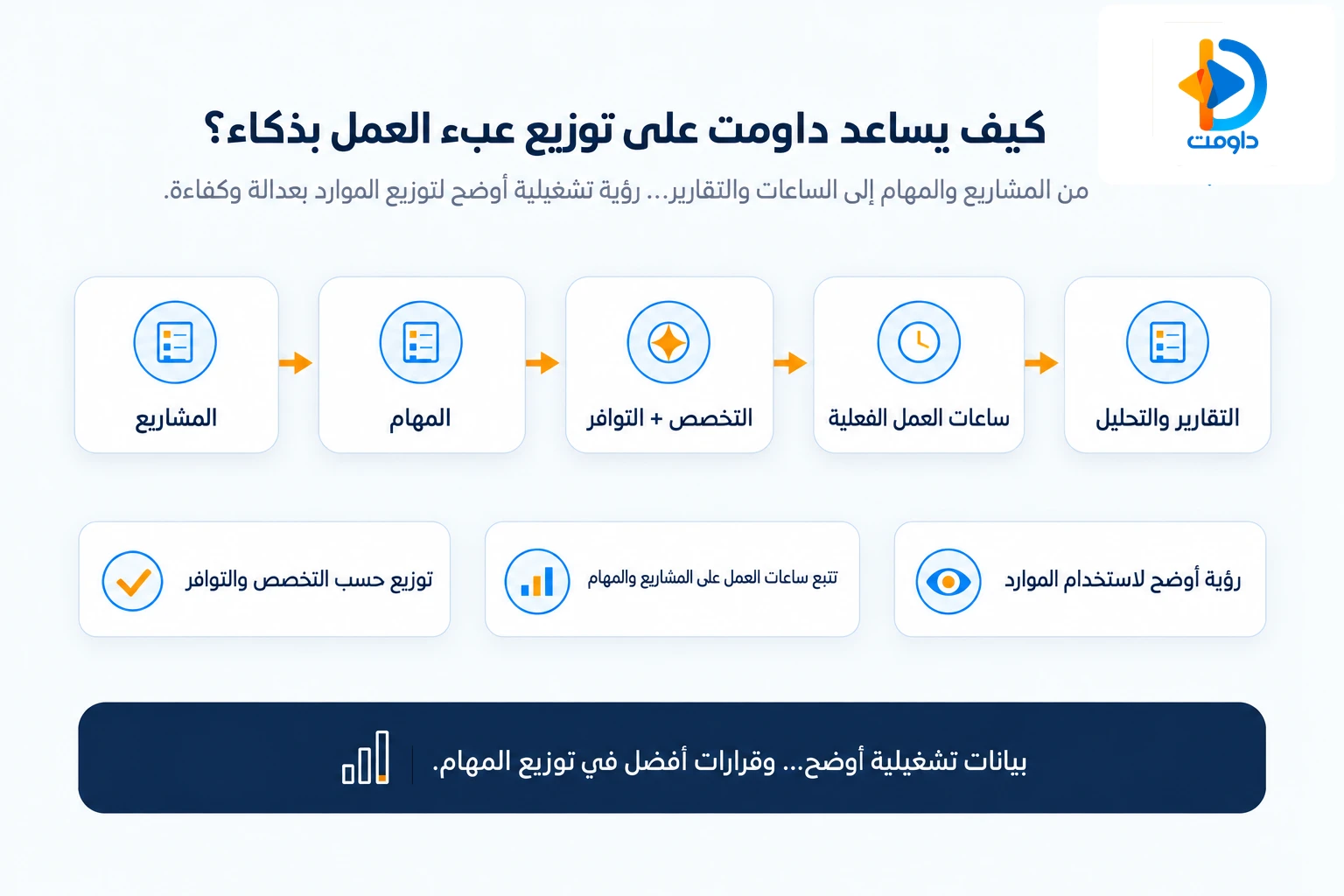
Dawmt's official Project and Task Management capabilities allow organizations to create and structure projects and sub-tasks and assign them to employees.
According to Dawmt's published product features, projects and tasks can be assigned based on employee specialization and time availability.
The platform also provides operational visibility through:
Project and Task Structure
Organizations can add and classify projects and sub-tasks to organize work more clearly.
Assignment Based on Skills and Availability
Projects and tasks can be allocated according to employee specialization and time availability.
Actual Working-Hour Tracking
Managers can review working hours allocated to specific projects and tasks.
Resource Analysis
Project analysis can include the number of participating employees, actual working hours, and HR resource costs.
HR Cost Allocation
Organizations can review project costs from a human-resources perspective to support project cost analysis.
These capabilities do not mean that Dawmt automatically diagnoses an employee as “overloaded.”
The platform's role is to organize project, task, time, and resource data so that management can review the operational picture more clearly and make better-informed allocation decisions.
From Work Data to a Clearer Decision
Instead of asking:
“Who has the fewest tasks?”
a more useful management question becomes:
“Who has the appropriate skills and actual capacity to complete this task within the required timeframe?”
That shift makes workload allocation more closely aligned with operational reality.
Smart workload management is not about dividing task counts equally among employees.
It is an ongoing process that considers work volume, complexity, priorities, time, skills, and actual employee availability.
When projects, tasks, working hours, and resources are clearly organized, management is better positioned to identify imbalance early, redistribute work when necessary, and reduce excessive dependency on specific individuals.
The objective is not for everyone to have the same number of tasks.
It is for each person to have a workload that can realistically be delivered while supporting quality and sustainable team performance.
Sources
• World Health Organization — Mental Health at Work.
• World Health Organization — Guidelines on Mental Health at Work.
• UK Health and Safety Executive — Management Standards: Demands.
• UK Health and Safety Executive — Tackling Work-Related Stress Using the Management Standards Approach.
• International Labour Organization — Working Time and Work-Life Balance Around the World.
• Dawmt — Official Project and Task Management feature pages.
Editorial Disclaimer
This article is intended for general educational and management purposes. HSE guidance is used as a professional workload and work-stress management reference and should not be interpreted as a statement of legal requirements outside its jurisdiction.
Workload management is the process of comparing work demands with available time, skills, and resources, then allocating tasks and reviewing the balance regularly rather than relying on task count alone.
No. Tasks differ in effort, complexity, priority, and required skills, so fair allocation should consider expected effort, skill fit, availability, and each employee's existing commitments.
Dawmt supports project and task structuring, assignment based on employee specialization and time availability, actual working-hour tracking, and analysis of project staffing and HR resource costs, giving management clearer operational visibility when allocating resources.

A practical guide to managing workplace stress, identifying chronic pressure factors, reviewing operational patterns, and applying evidence-based actions that help HR teams and managers improve working conditions.

A practical guide to employee burnout, its causes and warning signs, and how HR teams can identify workplace risk patterns early without turning employee data into a medical diagnosis.